

Managing Parental Burnout: Signs, Symptoms, and How to Recover
The Invisible Exhaustion: A Parent’s Guide to Recognizing and Managing Parental Burnout: Signs, Symptoms, and How to Recover.
You love your kids fiercely. Yet lately, waking up to their voices fills you with dread instead of joy. You find yourself snapping over spilled milk, feeling completely detached during bedtime stories, and running on a battery that’s stuck at 1%.
If this sounds familiar, you aren’t a bad parent. You are experiencing parental burnout—a state of chronic, severe exhaustion that goes far deeper than regular day-to-day tiredness.
Here is how to recognize the signs, understand why it happens, and take realistic steps to reclaim your well-being.
What is Parental Burnout? (And How It Differs from Normal Tiredness)
Every parent gets tired. A good night’s sleep usually fixes normal fatigue. Parental burnout, however, is a psychological syndrome resulting from chronic parenting stress that hasn’t been successfully managed.
Think of your emotional and physical energy as a bank account. When your daily deposits (rest, support, hobbies) can’t keep up with your constant withdrawals (tantrums, scheduling, emotional labor), your account goes into a deep deficit.
The 4 Warning Signs of Parental Burnout
Psychological research identifies four distinct dimensions of parental burnout. If you recognize yourself in most of these, it’s time to pause and evaluate.
- Exhaustion in Your Parental Role: Feeling chronically drained—physically, mentally, and emotionally. You feel like you have absolutely nothing left to give.
- Emotional Distancing: Checking out to survive. You might find yourself going through the motions of feeding, bathing, and driving your kids, but you feel emotionally detached from them.
- Loss of Parenting Pleasure: Feeling fed up with parenting. Activities you used to enjoy with your children now feel like a chore or a burden.
- Contrast with Your Former Self: Looking in the mirror and realizing you don’t recognize the patient, energetic parent you used to be, which often leads to deep feelings of guilt and shame.
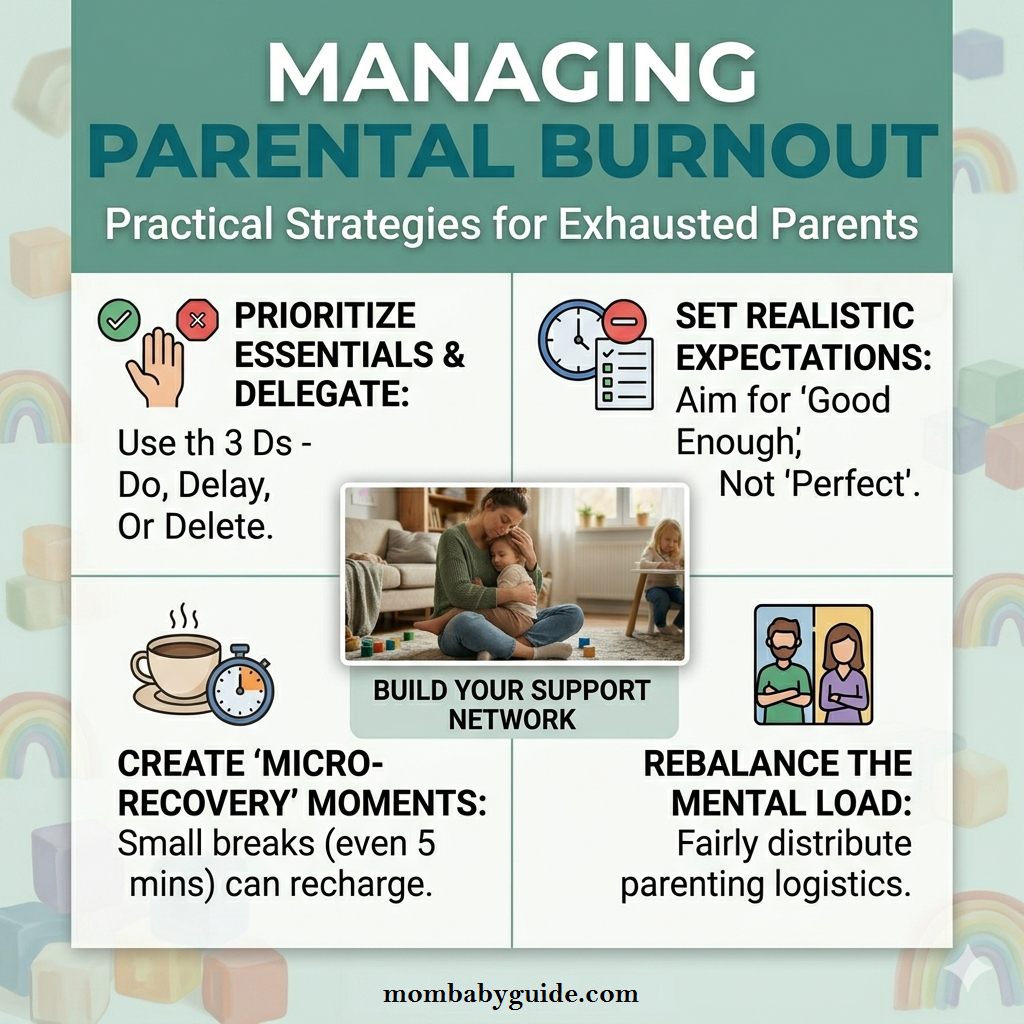
4 Actionable Strategies to Manage Burnout
Recovering from burnout doesn’t happen overnight, and it rarely happens by simply “trying harder.” It requires shifting your approach to daily parenting.
1. Shift from “Perfect” to “Good Enough”
The pressure to be a perfect parent—fueled by curated social media feeds—is a direct fast-track to burnout. Lower the bar intentionally.
- The Fix: Give yourself permission to serve frozen chicken nuggets, let the laundry pile sit for an extra day, or allow a little extra screen time when you are at your limit.
2. Radical Prioritization (The 3 Ds)
When you are burnt out, your cognitive load is too heavy. Audit your daily to-do list using the 3 Ds Framework:
- Do: What actually must happen today? (Feeding the kids, going to work).
- Delay: What can wait until next week or next month? (Organizing the playroom, deep cleaning the garage).
- Drop: What can you let go of entirely? (Baking cupcakes from scratch for the school bake sale).
3. Build Micro-Rest into Your Day
When you are overwhelmed, demanding a “spa weekend” or a “guy’s/girl’s night out” can feel impossible and logistically stressful. Instead, focus on micro-rests.
- The Fix: Take 5 minutes of absolute silence in your car before walking into the house. Put on noise-canceling headphones (while keeping your kids safely in sight) to dull the sensory overload of a chaotic afternoon.
4. Share the Mental Load
Often, burnout isn’t caused by the physical tasks of parenting, but by the mental load—the invisible logistics of remembering doctor appointments, tracking shoe sizes, and planning meals.
- The Fix: If you have a partner, sit down and explicitly hand over entire categories of labor, not just individual tasks. Instead of asking them to “help with dinner,” make them entirely responsible for meal planning, grocery shopping, and cooking on specific days.
A Vital Reminder
Taking care of yourself isn’t selfish; it is a prerequisite for taking care of your children. You cannot pour from an empty cup, and your kids don’t need a perfect parent—they need a regulated, healthy one.
If your feelings of exhaustion are accompanied by persistent feelings of hopelessness, severe anxiety, or thoughts of self-harm, please reach out to a licensed mental health professional. Parental burnout is real, treatable, and nothing to carry alone.
You May also like The 10-Minute No-Equipment Home Workout
To stay Connected with us Follow us on–